I've given up on a title cause nothing fits, but you could read it as "Ptolemy-OS" which Ptolemy is me and OS is like operating system which is my brain so like stuff from my brain? Like my brain's ramblings and whatnot... Dang it, that sounds smart should have gone with that
If you follow the mobile industry very closely you'll know that Sony released a new contender a few weeks back, the Xperia Z1!
So why another flagship, in such a short time. Well, for me, it was because when Sony released the Xperia Z, sure it was a nice phone, but it got bashed for having a lower end processor, the S4 instead of the S600 chip, the display was way, way, out of league compared to the other flagships and the camera was not up to par with the other flagships. So I guess this is Sony's answer and proof that it can actually produce a flagship worthy of competing with the other flagships. On paper, this phone does just that, if not excellently, on paper. It has the latest processor, the S800 clocked at 2.2 GHz, its a quad core processor, 2GB of RAM and 16GB of internal storage. That's to fire back at the lower end processor claim. For its display, Sony stuffed in its Triluminous display which for reviewers certainly did look nicer than Sony's previous displays but was not up to par with AMOLED or even Super LCD. Display, check. AND for the camera problem, SONY fitted a whopping 20.7M CAMERA!!! I know resolution isn't everything but what resolution does add to, just one example would be lossless zoom. Due to its high resolution, the camera can capture a lot of detail, allowing you to zoom in without losing detail, thus lossless zoom. But all these specs are only great on paper, but does that actually translate to real life performance?
The short answer, NO... disappointingly
Sony did get the processor right though, the phone does run buttery smooth and is always fast and snappy (based on reviews) so YAY PROGRESS!
But the Xperia Z was already fast and snappy to begin with so it did translate to a better phone, but the main attention was to the display and the camera. Both of which we will discuss right now.
Like I said earlier, Sony stuffed in its latest screen technology, the Triluminous Display with its Bravia successor, X-Reality but the screen still lacked the superb viewing angles other phone competitors provided. You could say who cares about looking at your phone from the side, when you will almost always look at your phone head on. Yes, that's true, but often a flagship phone is regarded as the best a company can offer or could offer. People associate the paper-like display of the HTC One and iPhone 5 with the word premium and this is something Sony doesn't seem to be able to provide. It's true it doesn't really matter, or maybe it does, but when other phones are able to pull it off, why not YOU?
Okay, but that 20.7M camera has to be good right? I mean, it's a TWENTY megapixel camera, how could it possibly be bad. Okay, first things first, Sony put in a 20 megapixel sensor that's larger than most sensors, meaning it can capture more light leading to better low light photography. Sony even put in its G-Lens and Bionz image processing into this. HOW COULD IT POSSIBLY BE A BAD CAMERA?!
So the camera is, wait for it, good but could be better. Yeap, you read that right, GOOD... but could be BETTER... HOW? I don't know, maybe Sony should take hints from Samsung, their flagship phones have excellent cameras. In fact, the Samsung S4 beat the Xperia Z1 in terms of picture quality. You can check the photo comparisons right here, if you want to check it out yourself. I'll leave the explaining to the photo comparisons. But trust me, you'll be disappointed.
Lesson learnt here, if you want to play with the big boys, you have to get your game on, enough to match them, and better yet, beat them.
There are up points though, everything does, this phone doesn't really do bad in anything, it just doesn't excel at beating the competition, and being a flagship, it should have been able to do just that. So its not bad, its just good... enough.
As you all know, I'm currently in my poke-chain, and this will be the last post, I wanted to post more, but a lot of other things came up that I feel like I should post about, so this will be the last of the poke-chain. This doesn't mean I won't be posting about pokemon anymore, it just means I'll be jumping from one subject to the other. I'm a pokemon fan, I've been playing pokemon my whole life, I cried when I found out you can play pokemon on your android phone, I'm playing pokemon on my android phone, the Sony Sola, and lastly, I'm playing Pokemon X!!! Muehehehehehehehe!!!~
Ok, back to the chain, my favourite pokemon, this time, it'll be just random pokemon, those random pokemon I've just taken a liking for. Those kind of pokemon.
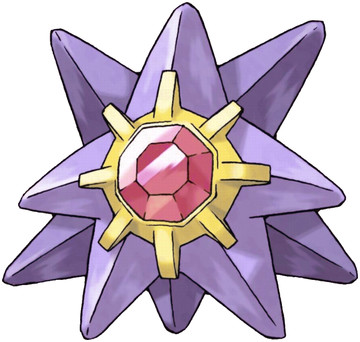
Starmie
Starmie was one of those pokemon that appealed to me when I looked at it and made me like it even more when I found out what I could do with it, IT COULD FRIGGIN LEARN THUNDERBOLT!!! If you guys don't know, Thunderbolt and Ice Beam are a very good combination of attacks you can teach one pokemon. This is simply because, if you teach these two moves to one pokemon, you practically cover half of the weakness of all the types of pokemon. Now, add psychic and hydro pump, and you get an all rounded addition to your team, which is something very convenient to have both adventuring and competitive-wise.
Haunter
Haunter appealed to me for two things, it looked awesome, one, and it's a ghost pokemon, two. Have nintendo make Haunter the only ghost pokemon in the first installment of pokemon and you have the perfect recipe for an instant, Faruq-approved pokemon. If you were wondering why Haunter and not Gengar, it was because I played pokemon on my computer when I was small and not the Gameboy so there was no way I could get Gengar. All I had after cheating was a level 100 Haunter, which still destroyed everything in its path, not sure whether Haunter was just strong to begin with or because he was level 100, though.
I also learned later on that Haunter could also learn a wide variety of moves, and I got a Ghastly 5 minutes after that.
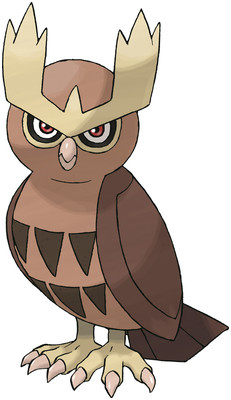
Noctowl
Now Noctowl didn't have anything else to offer me other than that initial good impression it had on me, and it could learn Hypnosis and Dream Eater, one of my favorite combos to have in Pokemon. But that's all it gave me in the end, it didn't have blazingly high stats or an impressive move set to begin with but it's still one of those pokemon I would definitely use in my team. Until I found out how stressful it was to land a Hypnosis and Dream Eater from Noctowl did not dish out as much damage as I would have hoped for, so I got a Pidgeot instead with more accurate and powerful moves.
Ampharos
Electric-type pokemon are one of those hard to find pokemon in the entrie game. The game either gives you a lot of them but none of them are good or few of them but most of them are also not good. Now Ampharos is one happy exception, which is why he is one of my favourite pokemon. To add to all this, he has excellent stats and his move set is quite good as well.
Gardevoir
For me, Gardevoir was the Alakazam for the Hoenn Region and it was a welcome replacement. And add an excellent design to the pokemon, you get an irresistable pokemon attracted by many.
Ludicolo
The third generation was one of the first generations to get a little crazy with the type mixing. For me, Ludicolo was the successful outcomes from those experiments. It really amazed me at how they managed to pull off the grass water design to create one that would actually protray both but also Ludicolo was a good addition to the team due to its bulkiness.
Remember when I said about crazy type mixing, here's another favorite,
Breloom
It's cute, and it is terribly good at punching the lights out of other pokemon. It reminded me of the Yugi-Oh Spell Card with the kangaroo punching out an opponent. It was unique being the first pokemon that was Grass and FIGHTING! Of course it had the weakness to Flying-type pokemon but it overcame that with Sky Uppercut~
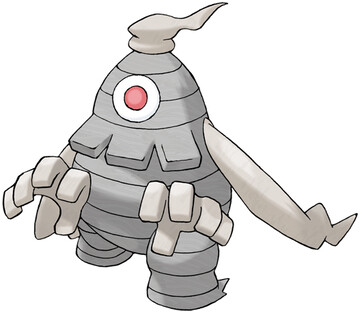
Dusclops
I just like Ghost Pokemon, just, like that~
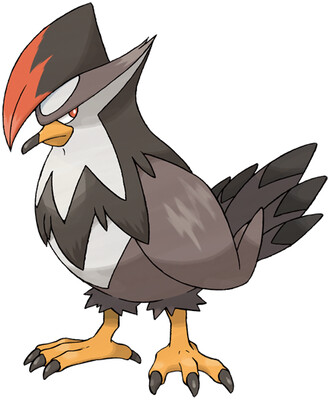
Staraptor
Staraptor earns points for being one of the coolest bird pokemon, one of the earliest additions to your team, one of the strongest early additions to your team, one of the bird pokemon with good movesets AND just a reliable pokemon on a whole.
He has helped me through a lot of battles in Diamond and Pearl, right up to the League and even after. So he shall forever be, one of my favorite pokemon.
I even had to get in Black and White and through breeding and some training, EVs and leveling, I had my good ol' Staraptor back!
Luxray
Luxray rides alongside Staraptor for being just plainly, RELIABLE! And also cause I thought he was Electric Dark. He wasn't but his moveset suggests otherwise. He was also one of the pokemon I brought over to Black and White.
Chandelure
Did you mention I simply love ghost pokemon? Well, I LOVE GHOST POKEMON!!! And that's why I when I saw Litwick I just... I just threw any pokeball I had at that time at him. And Lampent looked awesome, but Chandelure WAS JUST SHOOOOOOOOWWWW AMAYZINGGGGG!!!! Why have they not thought of a pokemon like this before?! It didn't have much of a moveset but it could learn very good moves and a wide variety of them too =)
And I guess that's it for this post, keep playing pokemon everyone~
With X and Y coming around the corner, I can't help but think back on the pokemon I had back then and which ones I like the most throughout various games. So here's a list of my favourite pokemon, not according to numbers because each of them has their own uniqueness I can't bear to numerate. To be fair, I'll group up certain pokemon that are in similar categories. (I'm making this as a part of a Poke-Chain, so stay tuned for more pokemon posts, minimum 3, I'll try my best)
Starters
SQUIRTLE!!!
I have to admit, Squitle is one of my favourite pokemon simply because it was the first pokemon I picked when playing Pokemon Blue. That alone can be the reason why, but Squirtle was one of those pokemon that went like, the more I used it and the more I transitioned into the game, there was just more to like about him, and he never let me down when it came to battling.
What I remembered the most was how cool Bubble looked in Red and Blue, and I compared it to Ember and Leech Seed. Ember was okay but there was nothing that made it seem extremely strong with its animation and Leech Seed always missed when I tried to land it. But BUBBLE OHHHHHHH MAN, the bubbles would move towards the enemy and the screen would flash every time it got closer. The next thing would be the enemy fainting, and I don't know it just made Squirtle look so strong!
He was also a joy to use against Gym Leaders, Brock would be decimated just by spamming bubble, Misty was taken care of with bite, I can still remember Starmie flinching with each bite, until it fainted. And since Squirtle was a water type, he just tanked those water attacks. Now remember, at that time, Bite was a normal type move, so when bite got upgraded to a Dark type move, I was all,
What a happy accident!
I didn't even have to use Pikachu! AND IT JUST GOT BETTER!!!! When he evolved into Blastoise, I taught him Ice Beam before I fought Sabrina. AND THE COOLEST THING HAPPENED!!! I USED ICE BEAM AND ALAKAZAM WAS FROZEN!!! Which made that battle a lot easier. Skull Bash just added to this, taking out Blaine's pokemon easy peasy~
I can go on and on about how cool Squirtle was for me, but I think you get the picture. =)
Cyndaquil
Ok, I have to admit, the only reason I picked Cyndaquil over Totodile was that Cyndaquil was SOOOOOOOOOOO CUTE. And also the fact Flame Wheel just looked too cool of a move to pass up. Another thing I came to appreciate was that it was hard to find a reliable Fire Type pokemon so having Cyndaquil on my team made this so much easier for me!
Torchic
There's actually a story behind this, I actually picked Swampert as my first starter but that was a game played with cheat codes using a GBA Emulator. When I tried to enjoy the game without using cheats, meaning starting over, I picked Torchic because, Swampert didn't look so nice, IMO and Blaziken was simply way wayyyyyyyyyy COOOLER! Top that with the fact that he was Fire Fighting (that was the first time so it was a big deal) and Sky Uppercut would destroy Flying pokemon which was what made me prefer Torchic over Mudkip. (Oh, yea, that's what its called)
Piplup
I know most of my choices are based on looks, but hey, human being rely the most on their eyesight so, you know, its... a fact? But yes, I chose Piplup because it looked the nicest among the starter pokemon in generation 4. For me, that was also when pokemon started coming up with bad designs for their pokemon, I hated the fact Yanmega looked nothing like Yanma (aside from the fact they were both dragonflies). Piplup was also the most controversial pokemon for me because Empoleon's sprite didn't exactly look very nice in game, it was drawn nicely in the book though.So yeah, it looked cute but when you got to Empoleon, I was like, WHUT....? 0.o But Empoleon was trustworthy in battle and the fact that he was Steel allowed me to tank normal moves LAIK A BAWS!!!!
Oshawott
Probably by now, you'd realise that I never picked a grass starter, well, to put it simply, WRONGGGGGGGG!!! I did, just that, Grass pokemon were relatively easy to find earlier in the game compared to the other two types and its not like I didn't like any of the starters, contrary to that, I actually liked all the grass starters, just not as much as the ones listed here! =) The story with Oshawott is simple actually, he looked cute, I chose him as my starter, he didn't disappoint in battle and his unique skill was a joy to use!
JUST LOOK AT THOSE, HOW COULD THAT NOT BE COOL?!
And there you have it, my favourite starter pokemon! So for this upcoming X and Y, I'll be partying with Fennekin and me ol' buddy Squirtle! OUR FRIENDSHIP TRANSCENDS TIME I TELL YOU!!!! TIME!!!!!!!!!!!
Pokemon X and Y are coming out in two weeks time!!! WOOOOOOOHOOOOOOOO!!!
And here are some hopes and dreams I have for the new pokemon game, just as the title suggests~
Just as a post starter~
Now, if you've been a fan of Ghost Pokemon, you'd probably know that there hasn't been any significant changes to ghost pokemon. And I mean in almost every aspect, first of all, ghost pokemon receive very few additions per new game released. I'll just make a list to show this,
First Generation
Ghastly
Haunter
Gengar
Second Generation
Misdreavus
Third Generation
Shedinja
Sableye
Shuppet
Banette
Duskull
Dusclops
If you count out the evolutions and legendary pokemon, you only get 1 pokemon in the 1st and 2nd gen, you get 4 in the third, fourth and fifth. It's sad once you think about how rich and diverse the ghost stories are with each culture and have only THIS many ghost pokemon.
To make things worse, ghost pokemon don't actually have a wide skill set for their type. I remember during the first generation ghost pokemon only had like 3 moves, Lick, Night Shade and Confuse Ray... To top it all off, none of those moves allowed ghost pokemon to showoff their prowess. They managed to remedy that by allowing ghost pokemon to learn a myriad of skills, like electric and psychic but when you use a skill that matches your type, your power is increased by 1.5 which makes it SO SAD to be ghost pokemon.
Things did lighten up with Gold and Silver where they introduced (FINALLY) a special attack that was also strong enough to be a nuke, Shadow Ball. They also added Curse which did stand out from the usual attacks, Spite and Nightmare.
But entering a new generation opened up other flaws Ghost pokemon had. Remember Banette? That pokemon had a high attack stat but the only physical ghost move available were Shadow Punch and Shadow Claw, with 60 power and 70 power, they weren't weak but they definitely lacked usability against higher leveled opponents, you know, with higher defense and hit points.
The fourth generation did bring a new physical move, Shadow Force but only Giratina had that ability. So the fourth generation had very little impact on ghost pokemon usabilty in this matter.
The fifth generation brought some nice type mixing to ghost pokemon, supplying you with a ghost fire, ghost water and ghost ground pokemon, but again their skill set didn't undergo any major changes.
I know not everyone uses ghost pokemon but it would be nice to have more options when you want to use them.
So I hope when X and Y come out, ghost pokemon would have a wider skill set and a larger variety! =) Let's keep our hopes up!
Okay, today I'm going to shed some light on smartphone camera tech and I'll be getting help from Nokia to provide me with some visual aid, so watch this video first and it'll help with the explaining later on =)
2 minutes should be too long, so please watch it, I'm not working for Nokia, if that's what you're thinking but they advertise their camera tech a lot and they just so happened to release this video~ It will seriously help later on, trust me. =)
If you're done watching the video, keep it open so you can easily refer to it should you need to, and I'll try to explain as much as I know about each feature they show you!
Starting with.... THE FLASH
Just to satiate those who thought of this when I mentioned flash (you're welcome =D)
Okay, I'm sure if you are one to compare specs or the company just likes promoting their product, you've probably heard of Xenon flash, and LED flash and also with the new iPhone out, Dual LED?
That's exactly what they showed you at the start of the video when the flash went off before capturing the picture. At just around 0.03 secs to be exact.
The phone in the video is equipped with a Xenon Flash, whilst other phone manufacturers would usually opt for the LED flash. Just to give you a heads up, Xenon Flash is better, but why? Let's get to it~
LED Flash speaks for itself, it's an LED (Light Emitting Diode) that's supposed to provide some sort of lighting when light is absent. The thing is, LED's don't emit light that travel very far. A Xenon flash is capable of emitting light 3 times farther than the regular LED. And that's just one of its upsides, the light emitted is also stronger so it can illuminate the object better and the fact it travels farther means you get more even lighting to a picture than something the LED flash would cook up.This also means more noise can be reduced and this all translates to a better photo overall.
Here's some photos to demonstrate the difference:
LED Flash
Xenon Flash
photos are taken from black phoebe, check it out here
Now dual LED flash is something different. Dual LED flash fires off a flash and then another following the previous flash. This translates to better lighting overall but at a cost of colour. The flash can often wash out the colours because of the immense light it releases. And it doesn't really help with providing even lighting because it is still LEDs so the light doesn't really travel farther.
Apple has introduced a Dual LED flash but this time, they've put two different LEDs, one white and one amber to prevent the washed out colours I've talked about before, does it really do well? Well, honestly I still don't know yet so we'll see.
Now don't go smashing every camera that doesn't provide a Xenon flash just yet, first of all, manufacturers don't opt for it because its more expensive, takes up more space (the phone would have to be thicker) and also it uses more battery power. There are also other ways to help a camera perform in low-light conditions.
Shutter and Aperture
MOVING ON! After the flash goes off and the light bounces off and moves towards the phone, you see, the rays entering the camera, right? When it is about to enter the lens, you see it opening, that's the shutter. The shutter limits the amount of light that enters the lens to generate the image. So often when you want to capture low light photos, the camera often prolongs how long the shutter remains open so more light can enter.
Another part worth noting is how big the hole or the more fancy term, "aperture" is, the bigger the aperture, the more light can be captured without affecting how long the shutter remains open. This also allows for the pictures generated to have a greater depth of field. A good example would be, the new iPhone 5S, which has a greater aperture than the previous iPhones. So, to cut it short, the smaller the aperture value, the more light can be captured and your pictures will have a greater depth of field. The iPhone 5 has an aperture value of f/2.4 whereas the new one has the aperture value of f/2.2. See, the smaller the number, the bigger the size of the aperture. Like I said, there are other ways to get good photos in low light and it involves these elements, hardware and software, working together, harmoniously, courtesy of Jony Ive (hatechu)
Image Stabilization
Following the video, after that, the light travels through a series of lens and then there's like a bearing moving around, right? Well, that bearing right there, is used to stabilize the lens because when it comes to taking photos, our hands are our worse enemy. They shake and move around and make it hard for you to produce a better picture. Ever so often when taking photos, they shutter speed is fast enough that your hand moving will not effect the quality of the picture taken. Much like how when they want to freeze a fast moving object in a picture, they use a very high shutter speed to capture the image, in the camera's point of view, at the point of time when the picture is taken, your hand is as though it was frozen in place.
But I did mention that when in low-light or when its dark, the shutter has to remain open longer to get more light. But doing this opens the picture to shake and to cut things short, the image turns out blurry. To counter this, you can use a tripod but carrying a tripod everywhere isn't the easiest of tasks to carry. Well, manufacturers have introduced Image Stabilization. The two common ones are DIS (Digital Image Stabilization) and OIS (Optical Image Stabilization) which is also sometimes known as Mechanical Image Stabilization.
DIS is done completely through programming, hence the name. By reducing the actual Field of View captured by the camera, they reduce the shake affecting the camera. Other methods also include increasing the sensitivity of the sensor (we'll get to that later) at the time when the shutter is closed and etcetra. However, this is not the best of image stabilization technology and sometimes can be buggy. Some also don't like the fact is reduces the camera's field of view.
This is where OIS comes in. Optical Image Stabilization is where the lens is physically mounted on a motor that will move the lens in the opposite direction the camera shakes to, leading to a better image. And because it does this much more effectively than DIS, having OIS in a camera also means better low-light performance. DIS is usually used because its cheap and OIS often makes the camera more bulky.
Sensor
Letting the video move once more, you'll see the light passing through a series of lens and then the light hits like a panel that has tiny squares on it, igniting each square the rays hit right? Well, what you're looking at there is the camera sensor. Notable keywords you should have in mind are CMOS, BSI, BI, and if you like more fancy names, Exmor R, Exmor RS. Those are all camera sensors. The typical camera sensor would be a CMOS Sensor, simply because its smaller and that right there has led to cameras being mounted on smartphones. So almost all smartphones use CMOS Sensors. Now how about BSI? Well, first of all, BSI and BI are the same thing, they stand for Backside Illuminated and Back Illuminated respectively. Are they different than CMOS sensors? They are CMOS sensors, to begin with, its just that BSI Sensors have their circuitry moved around a bit. To actually show why this is relevant, I'll have to explain how CMOS sensors work. (Don't worry, I'll make it short as possible)
CMOS Sensors have three layers, the first layer is are filters, Red, Blue and Green, the next layer is metal wiring and the last layer is the photodiode where light is converted into data to produce the picture. Here's the diagram.
photo is courtesy from Sony Global
The orange lines represent the light rays, and if you look carefully, you'll see that the metal wiring reflects some of the light back through the filter making it less efficient. That's where BSI comes in, one that Sony calls the Exmor R Sensor.
Sony shifted the photodiode layer with the metal wiring, but to doing so, see the green line indicating the front side of the substrate, yes, doing so, also point the front side downwards, so now the photodiode is illuminated from the back, hence the term Backside Illuminated. This is done so that the light won't reflect off the metal wiring thus making the sensor more efficient at capturing light. With the conventional CMOS sensor, the light capturing rate would be between 30-80% but with the BSI sensor, the capture rate would be 100%.
But what does this all mean for picture quality? The cameras would be better at low-light photography, which is why in Sony's Advertisements, they would say "great pictures in any light". Also, it would better picture quality in terms of noise and color reproduction as well as depth of field and contrast. Most high end devices come with BSI sensors so now you know what that implies.
Also courtesy of Sony, this can all be found on their Sony Global Page
Exmor RS, is simply the Exmor R that has been reduced in size so that the sensor wouldn't take as much space.
Okay, that's all I would be able to explain with my understanding based on that video, the rest of the video simply explains how all that light is shown on the phone's screen.
Hopefully, now you'll be able to understand more when manufacturers market their smartphone camera technology =)